Which Billing Type Should I Use in Momentum AMS?
Choosing the correct billing type in Momentum AMS starts with understanding how the premium is actually being transacted. The most important question is whether the premium flows through your agency's Premium Fund Account or is handled outside of the agency. Once you know how the money moves, you can determine whether the transaction belongs to the Agency Bill or Direct Bill family and select the appropriate billing type.
Available Billing Types
Momentum AMS includes the following billing types:
- Direct Bill 100%
- Direct Bill with Agency Down Payment
- Direct Bill – Autopay
- Direct Bill – Third Party Billed
- Agency Bill 100% (Billed Monthly)
- Agency Bill with Outside Financing
- Agency Bill – Paid In Full
- Agency Bill – Broker Billed
While the names describe different billing arrangements, you should not choose a billing type based on the name alone.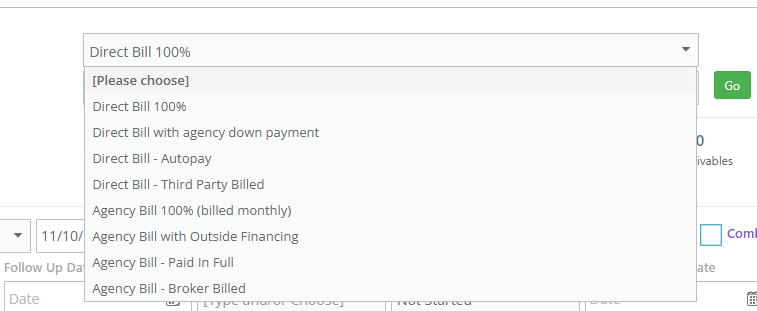
Start by Following the Money
The first question to ask is:
Is the premium being transacted through the agency's Premium Fund Account, or is it being handled outside of the agency?
This determines the first major part of the decision.
Money Flows Through the Agency
If premium is received and transacted through your agency's Premium Fund Account, the transaction generally belongs to the Agency Bill family.
The agency is typically responsible for receiving funds and disbursing the appropriate amount to the carrier, MGA, broker, or other party.
Money Is Handled Outside the Agency
If premium does not flow through your agency's Premium Fund Account, the transaction generally belongs to the Direct Bill family.
Once you have determined the appropriate family, look at the specific arrangement to select the correct billing type.
Direct Bill 100%
Use Direct Bill 100% when the carrier handles the premium billing and collection directly with the insured.
The premium does not flow through the agency's Premium Fund Account.
Example: The carrier invoices the insured, the insured pays the carrier, and the agency does not collect any portion of the premium.
Direct Bill with Agency Down Payment
Use Direct Bill with Agency Down Payment when the carrier is responsible for billing the insured, but your agency collects the initial down payment.
The agency handles the down payment while the carrier handles the remaining premium billing.
Example: Your agency collects the initial payment at binding and sends it to the carrier. The carrier then bills the insured for the remaining installments.
Direct Bill – Autopay
Use Direct Bill – Autopay when the premium is handled as a Direct Bill transaction and the applicable billing arrangement uses automatic payments.
The premium is not being collected and disbursed through the agency's Premium Fund Account as an Agency Bill transaction.
Direct Bill – Third Party Billed
Use Direct Bill – Third Party Billed when another party is responsible for handling the billing and the premium is not being transacted through your agency's Premium Fund Account.
When a third party is involved, focus on how the money moves rather than simply the name or type of company handling the transaction.
Agency Bill – Paid In Full
Use Agency Bill – Paid In Full when your agency collects the premium through its Premium Fund Account and is responsible for paying the carrier, MGA, broker, or other applicable party.
Example: The insured pays your agency $10,000. Your agency deposits the premium into its Premium Fund Account and then disburses the appropriate amount to the carrier or MGA.
Because the premium flows through the agency, this is an Agency Bill transaction.
Agency Bill 100% – Billed Monthly
Use Agency Bill 100% (Billed Monthly) when your agency is responsible for billing and collecting the premium through the agency's Premium Fund Account on a monthly basis.
The distinguishing factor remains that the agency is handling the premium funds rather than the carrier or another outside party.
Agency Bill with Outside Financing
Use Agency Bill with Outside Financing when the premium is financed through an outside premium finance company and the funds are being handled through the agency's Premium Fund Account.
This distinction is important because the presence of a premium finance company alone does not determine the billing type.
Premium Financing Does Not Always Mean Agency Bill
One of the most important distinctions involves premium financing.
Do not assume:
Finance Company = Agency Bill with Outside Financing
The deciding factor is still how the premium is transacted.
For example, a company such as Ascend may provide financing while handling the transaction more like a Direct Bill arrangement.
If the premium does not flow through your agency's Premium Fund Account, the transaction should generally be treated as Direct Bill, even though a finance company is involved.
If the financing arrangement results in funds flowing through your agency's Premium Fund Account and your agency is responsible for disbursing those funds, Agency Bill with Outside Financing may be appropriate.
Agency Bill – Broker Billed
Use Agency Bill – Broker Billed when your agency is billing another agent or broker rather than billing the insured directly.
This is commonly used in MGA or wholesale workflows where the retail agent maintains the billing relationship with the insured.
The retail agent or broker is billed according to the applicable broker-billing arrangement rather than creating an insured invoice.
Quick Billing Type Examples
| Scenario | Billing Type |
|---|---|
| Carrier bills and collects directly from the insured | Direct Bill 100% |
| Agency collects the down payment, carrier bills the balance | Direct Bill with Agency Down Payment |
| Carrier/third party handles billing using an automatic payment arrangement | Direct Bill – Autopay |
| Another party handles billing outside the agency | Direct Bill – Third Party Billed |
| Agency collects the full premium and pays the carrier/MGA | Agency Bill – Paid In Full |
| Agency collects and bills premium monthly | Agency Bill 100% (Billed Monthly) |
| Outside financing is used and funds flow through the agency's Premium Fund Account | Agency Bill with Outside Financing |
| MGA/wholesale agency bills the retail agent or broker | Agency Bill – Broker Billed |
If a Finance Company or Third Party Is Involved
When another company is involved in the transaction, don't select the billing type based solely on that company's name.
Instead, identify the complete movement of money:
Insured → Agency → Carrier/MGA
or
Insured → Finance Company/Third Party → Carrier
or another applicable arrangement.
Ask:
- Who collects the insured's payment?
- Does any of that premium enter the agency's Premium Fund Account?
- Who pays the carrier, MGA, or broker?
- Is the agency responsible for disbursing the premium?
Those answers will usually identify the appropriate billing workflow.
Best Practice
Before generating a transaction, verify that the billing type represents the actual movement of money.
A useful rule to remember is:
Follow the money, not the label.
Start by determining whether the premium flows through the agency's Premium Fund Account.
Premium flows through the agency → Agency Bill family
Premium does not flow through the agency → Direct Bill family
Then select the specific billing type that represents the actual arrangement.
What If I Already Used the Wrong Billing Type?
If accounting transactions have already been generated using the wrong billing type, do not simply change the billing type on the existing transaction.
Generated accounting may need to be properly unwound before the transaction can be rebuilt.
Refer to How to Correct the Wrong Billing Type in Momentum AMS for the proper correction workflow.
Summary
Choosing the correct billing type in Momentum AMS is less about what the transaction is called and more about how the premium actually moves.
Start with one question:
Does the premium flow through my agency's Premium Fund Account?
If yes, start with the Agency Bill options.
If no, start with the Direct Bill options.
From there, consider whether the transaction involves a down payment, monthly billing, outside financing, autopay, third-party billing, or broker billing to select the specific billing type that most accurately represents the transaction.
Was this article helpful?
That’s Great!
Thank you for your feedback
Sorry! We couldn't be helpful
Thank you for your feedback
Feedback sent
We appreciate your effort and will try to fix the article